MoreExam
1. Question Content...
EXPLANATION
Answer: X - EXPLANATION Content.
Question1: Network administrators decide to change OSPF Area 1 to a stub area in order to solve some performance issues. No routes are redistributed into area 1.What is one implication of making this change?
Question2: A network administrator needs to create a QoS policy on an AOS-Switch. What is one component that the administrator must create before the policy?
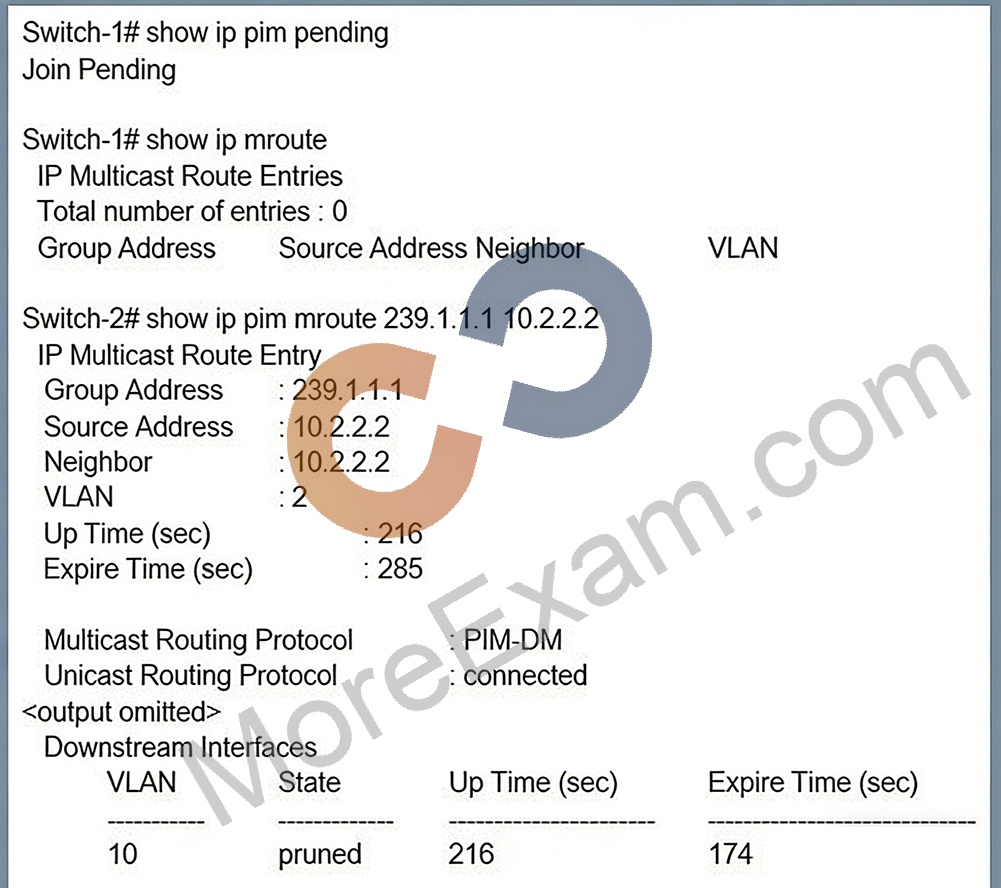
Question3: Refer to the exhibits.Exhibit 1Exhibit 2A network administrator sets up PIM-DM to route traffic from the multicast source to clients in VLAN 24.The server begins to forward multicasts, and the clients are set up to receive them. However, the multicasts do not reach the clients.Based on the output, what should the administrator verify?
Question4: A customer wants access layer switches that support routing, ACLs, VSF stacking, and SFP+. Which Aruba switch model meets the customer's requirements?
Question5: What is the minimum requirement for a device to pass local MAC authentication (LMA) on an AOS-Switch?
Question6: Refer to the exhibit.A company wants to change Area 1 shown in the exhibit from a stub area to a totally stub area.What will be one effect of this planned change?
Question7: A network administrator enters this command on an AOS-Switch:Switch(config)# radius-server host 10.1.3.3 time-window 60Which behavior will the switch show?
Question8: A company has a wireless Aruba solution and wired users that connect to AOS-Switches. The company wants deep insight into the types of applications that wired users run. The company also wants more control over the traffic.What can the company do to meet these goals?
Question9: Refer to the exhibits.Exhibit 1.Exhibit 2.The VoIP phone connects, authenticates successfully, and is dynamically assigned to tagged VLAN 6. The endpoint connected to the phone does not authenticate but starts to send untagged traffic.How does the switch handle this traffic?
Question10: AOS-Switches authenticate guests to ClearPass with captive portal. When guests first connect their device to the network, they are redirected to a captive portal in which they log in. ClearPass then stores the guest MAC addresses, and the guests are permitted access. Due to a conflict, the network administrator needs to change the dynamic authorization port, port 3799, on Aruba ClearPass.If the administrator forgets to also change the port on one of the AOS-Switches, what will be one symptom?
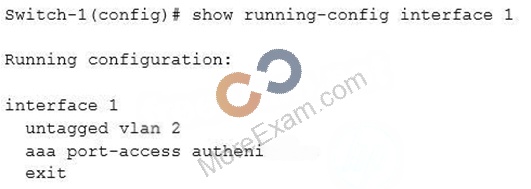
Question11: Refer to the exhibits.Exhibit 1Exhibit 2The IP phone in the exhibit is set up to complete 802.1x authentication to the network. How can the netwotk administrator prevent a user on the computer from receiving network access without authentication?
Question12: A network administrator can set the OSPF metric-type on an AOS-Switch to Type 1 or Type 2. What is the difference?
Question13: The security policy for a company requires that switches use SNMPv3 and accept all read-only SNMPv2c messages. The network administrator enables SNMPv3. Which additional action should the network administrator take to comply with this policy?
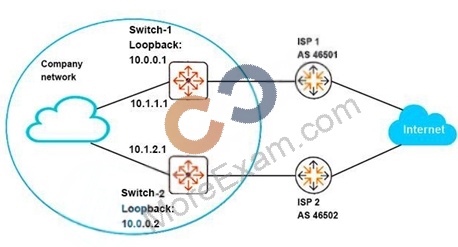
Question14: Refer to the exhibits.Exhibit 1Exhibit 2The network administrator needs to set up BGP between the two company switches, Switch-1 and Switch-2.The BGP connection does not establish. Based on the exhibits, what does the administrator need to do to fix the issue?
Question15: A company wants to implement role-based tunneled node on AOS-Switches. Which solution should be included in the plan to help apply the roles?
Question16: Refer to the exhibits.Exhibit 1Exhibit 2A network administrator wants to set up mirroring of traffic from port 1 on Switch-1 to port 1 on Switch-2.Exhibit-2 shows the commands that the administrator enters. The mirroring does not work correctly.What must the administrator do to correct the error?
Question17: Refer to the exhibits.Exhibit 1Exhibit 2Switch-1 and Switch-2 lost IP connectivity with each other. They did not detect the issue for several seconds and caused a temporary traffic disruption. The administrations expected failover to the backup route through Switch-3 to occur in less than a second. The administrators restore the failed link and view the output on Switch-1, shown in the exhibit.What should they do to create the expected behavior if connectivity is lost again?
Question18: Which benefit is provided by MD5 authentication for BGP?
Question19: Two 5400R AOS-Switches are OSPF neighbors. The network administrator wants routing paths to update as quickly as possible in the event of a failure on a neighboring switch.Which technology should the administrator implement on the connected switch interfaces?
Question20: The security plan for AOS-Switches calls for ARP protection. For ARP protection to function properly, which other feature should also be implemented?
Question21: Refer to the exhibit.Which issue needs to be addressed in this design?
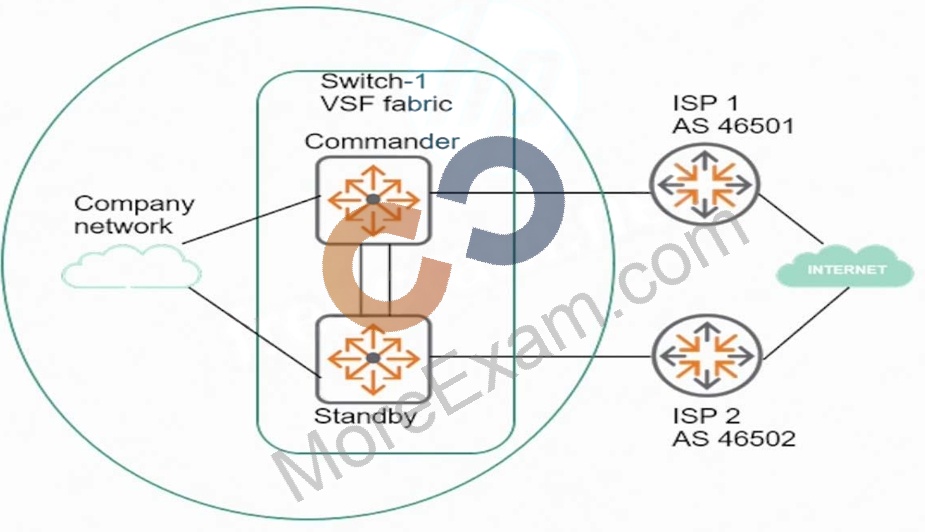
Question22: Refer to the exhibit.The company wants the fastest convergence and best load sharing of traffic over the links between Switch-1 and the VSF fabric. Which technology should the network administrator implement on these links?
Question23: Refer to the exhibit.Endpoints in VLAN 2 connect directly to this switch. These devices should only be able to send DHCP, DNS, HTTP, and HTTPS traffic. However, they are able to send any traffic. Based on the exhibit, what is the issue?
Question24: A network administrator configures VSF settings on two Aruba 2930F switches. The switches form two separate VSF fabrics. What should the administrator check?
Question25: Refer to the exhibit.Switch-1 and Switch-2 connect on interface A23. The switches experience a connectivity issue. The network administrator sees that both switches show this interface as up. The administrator sees the output shown in the exhibit on Switch-1.What is a typical issue that could cause this output?